Free CELPIP Reading Practice Test
Master the CELPIP reading practice test format with our comprehensive free test online. Perfect your reading comprehension skills with our free CELPIP reading test for Canadian immigration success.
About the CELPIP Reading Test
The CELPIP Reading Test is a vital part of the Canadian English Language Proficiency Index Program (CELPIP) and a key requirement for Canadian immigration, permanent residency, and citizenship applications. This test evaluates your ability to understand and interpret written English used in real-life Canadian contexts.
The reading section measures essential skills such as identifying main ideas, understanding key details, and interpreting information from emails, articles, diagrams, and opinion-based texts. With a focused CELPIP reading practice test, test takers can improve reading comprehension, increase reading speed, and work confidently toward achieving CLB 7+ or CLB 9+ scores.
Whether your goal is to meet CELPIP language requirements for immigration or to achieve a high CELPIP score, structured preparation makes a real difference. Practicing with our free CELPIP test online, including reading mock tests, exam-style questions , and clear answer explanations, helps you build strong skills, boost confidence, and perform successfully on test day.
60 minutes total
4 distinct reading tasks
Complete the sentence, Select the correct inference,
Identify the main idea or purpose, Interpret tone or attitude,
Vocabulary in context, Compare viewpoints or opinions,
Locate specific information
Pro Tip for Success
To maximize your CELPIP reading score, practice active reading strategies: skim for main ideas first, scan for specific keywords, and carefully read all instructions before answering. Use our free CELPIP test resources regularly to build familiarity with the format and improve your time management.
Reading Specific Preparation Strategies
Understand the Test Format
Familiarize yourself with the structure of each test section (Listening, Reading, Writing, and Speaking). Knowing what to expect will help you manage your time effectively during the test.
Reading Section
Skim through the passage first to get the gist, then read it carefully to answer the questions. Develop effective scanning techniques.
Reading Scoring
Objective Scoring
The Reading sections are scored automatically by the computer. Your score is based on the number of correct answers, which are then converted into the CELPIP scale.
Item Difficulty
The test includes a mix of easy, medium, and hard questions, and your score reflects the difficulty level of the questions you answered correctly.
Score Reference Charts
Reading Score Chart
| CELPIP Level | Reading Score / 38 |
|---|---|
| 10–12 | 33–38 |
| 9 | 31–33 |
| 8 | 28–31 |
| 7 | 24–28 |
| 6 | 19–25 |
| 5 | 15–20 |
| 4 | 10–16 |
| 3 | 8–11 |
| M | 0–7 |
Disclaimer
This example chart shows how scores in the Listening Test and Reading Test approximately correspond to CELPIP Levels. Since questions may have different levels of difficulty and may therefore be equated differently, the raw score required for a certain level may vary slightly from one test to another.
 Task 1
In this part, you will read two pieces of correspondence, typically in the form of letters or emails, and answer 11 multiple-choice questions. The first letter will contain general topics, such as a holiday or family event, and you’ll need to answer six questions based on it. The second letter is a response to the first one, followed by five questions.
11 (6 for the first letter, 5 for the response)
Skim the letters, find key points, and look for paraphrased information.
 Task 2
In this task, you’ll see a diagram or graphic along with an email that responds to it. You need to refer to the diagram to fill in blanks in the email and answer multiple-choice questions. This task tests your ability to understand connections between visual data and written text.
8 (5 fill-in-the-blanks, 3 multiple choice)
Analyze the diagram, relate it to the email, and use the dropdown options to fill in the blanks.
 Task 3
Here, you will read an informational text divided into four paragraphs. Your task is to match nine statements with the correct paragraphs. Some statements may not be supported by any paragraph, so the option 'Not Given' is also available. This task assesses your ability to extract specific information and understand the main ideas.
9 (matching statements to paragraphs)
Skim paragraphs for main topics, scan for keywords, and identify paraphrased information.
 Task 4
This section involves reading an opinion article from a website, followed by a reader’s comment on the article. You’ll answer five multiple-choice questions about the article, and then five questions based on the reader’s comment, where you will fill in the blanks with the best possible options. This task evaluates your ability to understand different perspectives and distinguish between fact and opinion.
10 (5 for the article, 5 for the comment)
Identify different viewpoints, skim for key ideas and names, and recognize paraphrased information.
CELPIP Reading Test FAQs
Get answers to common questions about CELPIP reading practice test preparation and scoring
Task 1 – Reading Correspondence
Read the following message
I’m writing about the pilot schedule posted yesterday at the Granville Public Library. According to the notice, from October 7 to November 30, all weekday closing times will move from 9:00 p.m. to 7:00 p.m., and study rooms after 5:00 p.m. will require a $6 per hour reservation fee, payable through the online portal only. I understand the need to manage staffing costs during a trial period, and I recognise that the library is attempting to gauge whether evening demand justifies current operating hours. However, I am concerned that the combined effect of an earlier closure and a digital-payment-only fee may inadvertently deepen what researchers call the digital equity gap—the uneven ability of residents to participate in services that have moved exclusively online—among precisely the learners who depend on the library most after work and school.
To explain my specific situation: I am a project coordinator commuting from Surrey to downtown Vancouver, and three evenings a week I meet my younger sister Nisha at Granville to prepare for her CELPIP test. We typically arrive by 6:10 p.m. after her shift ends. Under the new schedule we would need to pack up by 6:45 p.m.—barely thirty minutes of effective study time once we settle and log in to practice materials. I also tracked entry counts at the side door for the four Tuesdays preceding this letter: on each occasion, more than thirty patrons swiped in between 6:00 and 8:00 p.m., a figure that the front desk confirmed is consistent with their own gate tallies. Paying $6 per hour on top of transit fares and a $280 test registration fee may appear modest in isolation, but for many learners it functions as the threshold between staying and leaving. If Nisha and I relocate to a café, we spend more in beverages than the room fee—and the ambient noise makes listening practice impossible. Is the library’s goal genuinely served by that outcome?
Beyond our own case, I volunteer on Saturdays for the Homework Club and have observed that peak demand for quiet individual study falls squarely in the 6:00–9:00 p.m. window during midterm and language-test cycles. Several international students have told me directly that they lack both stable home internet and a distraction-free desk. An online-only payment system at 5:45 p.m. excludes anyone whose phone battery is low, whose data plan has run out, or whose bank card has been declined—even when study rooms stand empty beside them. These are not edge cases; they represent a structural barrier for the residents the library is mandated to serve.
I am not questioning the need to experiment with operating models; I am asking that the pilot be designed to measure the right outcomes. Could the branch preserve two late evenings per week—Tuesdays and Thursdays until 9:30 p.m.—so that learners who finish work after 6:00 p.m. retain meaningful access? Alternatively, waiving the evening room fee for any patron who presents documentation of an upcoming language exam or academic assessment would address the cost barrier without eliminating the pilot’s revenue data. A 15-minute grace period at closing would prevent the abrupt departures that currently leave students mid-exercise in the lobby. I am willing to volunteer on one late evening per week to assist with room checkouts if staffing remains the central constraint.
Thank you for considering adjustments that preserve the library’s role as an equitable public learning space—particularly for the evening learners whose participation the pilot’s current design may otherwise inadvertently discourage. A reply by October 4 would allow Nisha and me to plan her study schedule before the pilot begins.
Sincerely,
Arjun Mehta
Library Member #482917
Choose the best option according to the information given in the message:
1. What is the main purpose of Arjun’s message?
2. According to the pilot notice, which two changes take effect on weekdays from October 7?
3. Why does Arjun conclude that the evening room fee is likely to deter learners even more than the earlier closing time alone?
4. What can be inferred about the library’s own gate tallies from the information Arjun provides?
5. Arjun’s overall approach to the pilot changes is best described as ____.
6. What does Arjun offer to do personally to help ease the staffing constraint?
Here is a response to the message. Complete the response by filling in the blanks. Select the best choice for each blank from the drop-down
Task 2 – Reading to Apply a Diagram
Reference Image
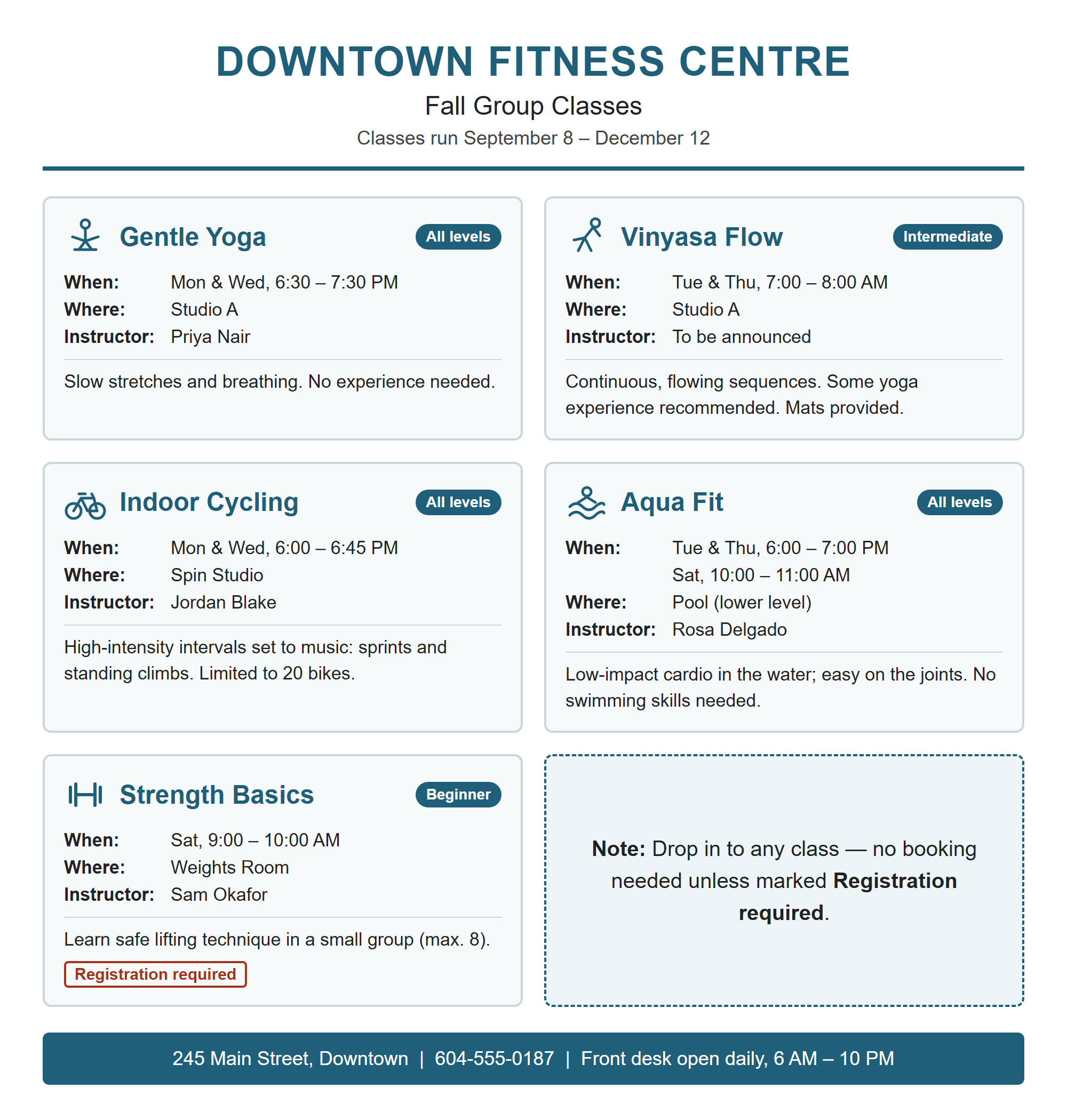
Read the following email message about the diagram on the left. Complete the email by filling in the blanks. Select the best choice for each blank
Sorry this took so long, but I finally picked up the fall guide at the front desk. It lists 12...., which is more than I expected.
Since your physio wants you off anything that pounds your knees but still wants you working up a sweat, I'd start with 13.....
You said you've never tried yoga, but don't rule out Vinyasa Flow: experience is 14..... My only hesitation is that 15...., so I'd find out a bit more before you commit.
Strength Basics looks promising too, but unlike the others, it 16...., so call the front desk first.
I'd invite you to join me on Mondays and Wednesdays, but forty-five minutes of racing uphill to loud music is probably the last thing your physio had in mind. Maybe once your knee has healed!
I'll bring the guide to Monday's staff meeting so you can have a proper look.
Nadia
Choose the best option:
17 What is the relationship between Nadia and Greg?
18 Which class does Nadia most likely attend?
19 Why is Nadia writing to Greg?
Task 3 – Reading for Information
Read the following passage.
When Canada achieved Confederation in 1867, its eastern and western territories were separated by an immense, largely uncharted interior. British Columbia agreed to join the federation in 1871 only upon the federal government's promise to construct a transcontinental railway within a decade. Fulfilling that pledge proved far more arduous than anticipated; the project was beset by political scandal, financial collapse, and the sheer geological ferocity of the Canadian Shield and Rocky Mountains. Nevertheless, the enterprise represented the most ambitious infrastructure undertaking in the young nation's history, and its completion was understood — both domestically and abroad — as the defining act of Canadian sovereignty.
The monumental task of construction fell, after considerable parliamentary turmoil, to a syndicate led by Scottish-born financier Donald Smith and his associates. Appointed in 1881, the consortium recruited American engineer William Van Horne to oversee operations; his relentless drive transformed what had been a desultory, intermittent effort into a coordinated industrial campaign. The workforce at its peak comprised upward of fifteen thousand labourers, including a substantial contingent of Chinese immigrants who were disproportionately assigned to the most perilous segments of track through the mountain passes. These workers dynamited through solid granite and constructed trestle bridges over precipitous gorges, often at considerable personal cost.
Financing the railway consumed prodigious capital and brought the syndicate to the verge of insolvency on multiple occasions. The federal government, under Prime Minister John A. Macdonald, extended emergency loans and land grants — ultimately transferring some twenty-five million acres of prairie land to the company — to sustain construction. The line was finally driven to completion at Craigellachie, British Columbia, on November 7, 1885, where Donald Smith ceremonially hammered the last spike. The railway's inauguration precipitated rapid agricultural settlement of the prairies, as the CPR actively recruited European immigrants and transported them westward, fundamentally altering the demographic composition of the interior.
The Canadian Pacific Railway's legacy extends well beyond its original mandate of territorial unification. Within a decade of completion, the CPR had diversified into hotels, steamship services, and telegraph operations, evolving into a vertically integrated commercial empire. Its famous Château-style hotels — including Château Frontenac in Québec City and the Banff Springs Hotel in Alberta — became emblematic of Canadian hospitality and remain operating landmarks today. The railway also proved strategically vital during both World Wars, facilitating the rapid mobilization of troops and materiel across the continent. In rendering the country's vast geography navigable, the CPR was instrumental in transforming Canada from a loosely confederated collection of provinces into a coherent transcontinental state.
Decide which paragraph, A to D, has the information given in each statement below. Select E if the information is not given in any of the paragraphs.
Task 4 – Reading for Viewpoints
Read the following article from a website.
Dr. Priya Nantha, a public health physician, contends that national pharmacare is overdue: nearly one in five Canadians skip prescriptions because of cost. “We ration medication by pay stub, not by need,” she says, arguing that the chronically ill and precariously employed are least able to afford drugs that would otherwise keep them out of hospital. For Nantha, the case is fiscal as much as humanitarian, since untreated conditions generate downstream costs that dwarf the price of medication.
Marcus Whitfield, an independent pharmacist representing the Pharmacy Owners’ Association, does not dispute that coverage gaps cause real harm. Where he diverges is on implementation. “Pharmacies are the shock absorbers of this system,” Whitfield says. “We negotiate with insurers, we accommodate patients whose needs fall outside standard plans, and an abrupt switch to one national formulary could wipe that flexibility out overnight.” A poorly sequenced rollout, he warns, could squander years of accumulated trust between pharmacists and patients. Whitfield favours a phased model in which the consolidation of purchasing power precedes the dismantling of existing arrangements.
Renata Costello, director of employee benefits at a manufacturing group, worries less about the principle than the timing. “We’ve spent decades building drug plans around our workforce,” she says, “and layering a public programme on top without coordination could push employers to drop coverage altogether.” Unionised workplaces, she notes, negotiated those benefits as part of broader packages that would be costly to unwind.
Dr. Aydin Farahani, a health economist, argues the debate has aimed at the wrong target. “The real question isn’t who pays,” he says, “it’s who governs the price once there’s a single buyer.” Canada pays among the highest brand-name drug prices in the OECD, he notes, precisely because purchasing power is fragmented across provinces, employers, and private insurers, none of whom can individually extract the concessions a unified buyer could command. For Farahani, pharmacare’s value lies less in universality than in institutional transparency: a single formulary would let policymakers see and negotiate prices presently hidden behind confidential, employer-specific contracts. Notwithstanding the transition concerns raised by Whitfield and Costello, he maintains that without consolidated bargaining authority, any pharmacare model will simply replicate today’s costs under a new name.